
Checking Fayette County Criminal History
Start with the record that answers the question. The Unified Judicial System of Pennsylvania Case Search is the broad public route for Fayette County criminal court cases. It covers Magisterial District Court and Court of Common Pleas dockets. The Fayette County Clerk of Courts supplies the underlying Common Pleas file and certified copies. The arresting police agency holds its own incident narrative, the Fayette County Jail records local custody, and the Pennsylvania State Police Central Repository produces the statewide PATCH response.
Gather the legal name, spelling variants, an approximate filing or arrest date, and a known docket or report number. A date of birth or middle name can help distinguish similar names, but a name match alone does not prove identity. Use the docket caption, court, filing date, arresting agency and charge history together.
- Search UJS under both Fayette County court levels and select the criminal case category.
- Open likely docket sheets and compare public identifiers, dates and the arresting agency.
- Read each charge and its disposition instead of relying only on the case status.
- Ask the Clerk or creating police agency for the underlying record that the docket does not display.
- Use PATCH when a Pennsylvania State Police repository result is the product actually needed.
Note: A booking entry, court docket and PATCH result may update at different times, so a careful self-review compares all relevant sources.
Fayette County's Three Record Problem
One Fayette County event can create three very different public trails. A jail entry describes intake and current or recent custody. A court docket follows the complaint, bail, charges, hearings and outcome. PATCH reports qualifying criminal history held in the PSP Central Repository. None is a substitute for the other two.
- Fayette Sheriff app
- Answers who appears in current county custody, not a person's full case history.
- UJS docket
- Shows filed case events and outcomes, but usually not the police narrative.
- PATCH
- Provides the PSP repository response, not a certified Fayette court file.
A release can remove someone from the current roster while the court docket remains. Charges can also be amended or withdrawn after booking. Match the docket number and final result before drawing a conclusion.
Pennsylvania Official Background Checks
Pennsylvania Access To Criminal History, known as PATCH, is the PSP name-based request channel. A standard individual or noncriminal-justice request costs $22. A notarized mail result costs $27, while an eligible volunteer request is free and cannot be notarized. Nonregistered online users may submit up to ten subjects in one session. Some no-record responses arrive at once. A request that needs manual comparison may remain under review for two to four weeks.
The official PSP criminal-history service page explains the products and status process. Preserve the PATCH control number and request date. A person seeking the fuller state access-and-review record uses mail form SP 4-170 and the documented $20 fee. That subject-review route can help when repository data appears incomplete or wrong.
The PATCH entry screen shows where a public Pennsylvania record request begins.
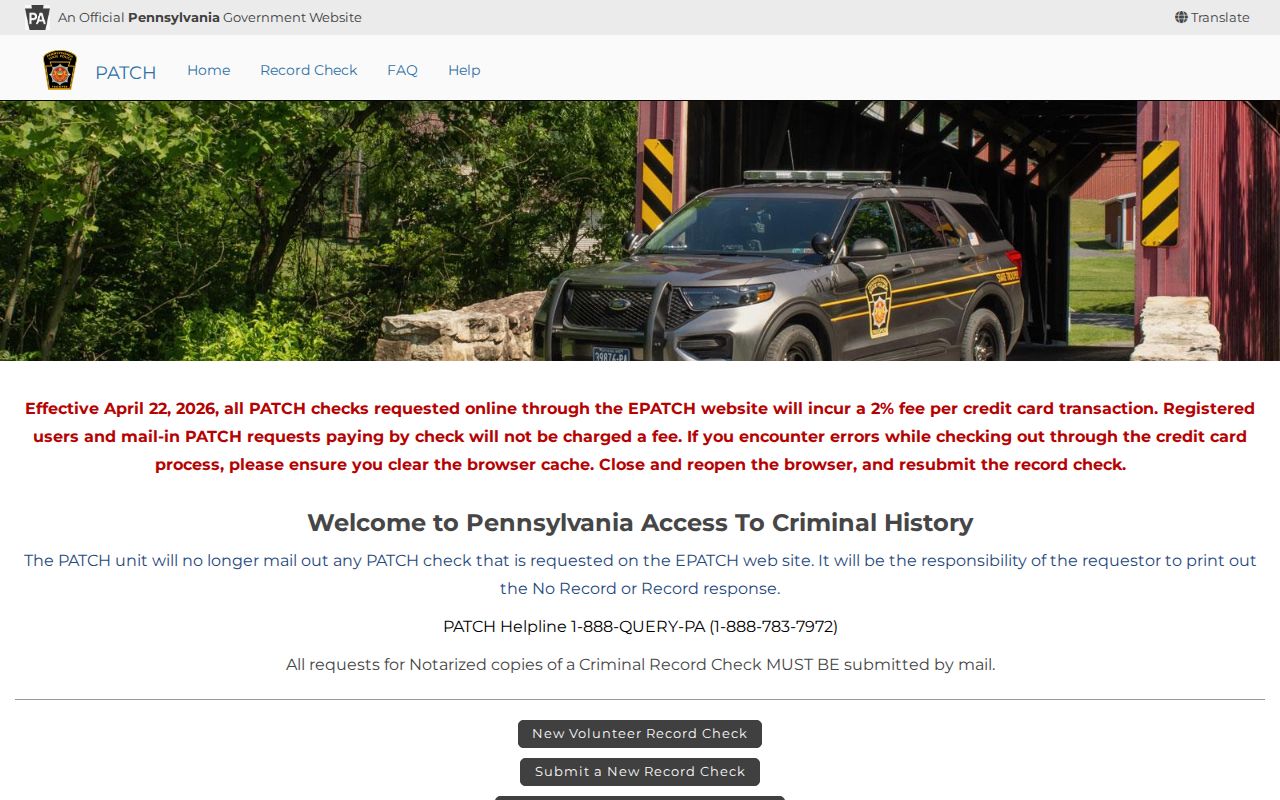
The screen leads to a PSP repository product, not the docket papers kept at the Fayette County courthouse.
| Official product | Method | Published fee |
|---|---|---|
| Standard PATCH request | Online or mail | $22 |
| Notarized mail result | SP 4-164 by mail | $27 |
| Personal access and review | SP 4-170 by mail | $20 |
| Fayette criminal-file copy | Clerk of Courts | $0.25 per page |
Fayette County Fingerprint Check Routes
Some Pennsylvania programs require an FBI fingerprint check rather than an ordinary name request. IDEMIA operates the Commonwealth's IdentoGO capture channel. Pre-registration and the correct agency service code come first. An appointment is recommended, although Pennsylvania says a pre-registered person may walk in during a site's operating hours. Fayette County locations and hours can change, so choose a current site during booking rather than relying on an old local listing.
The Pennsylvania IdentoGO location finder is the current enrollment and site-selection route.
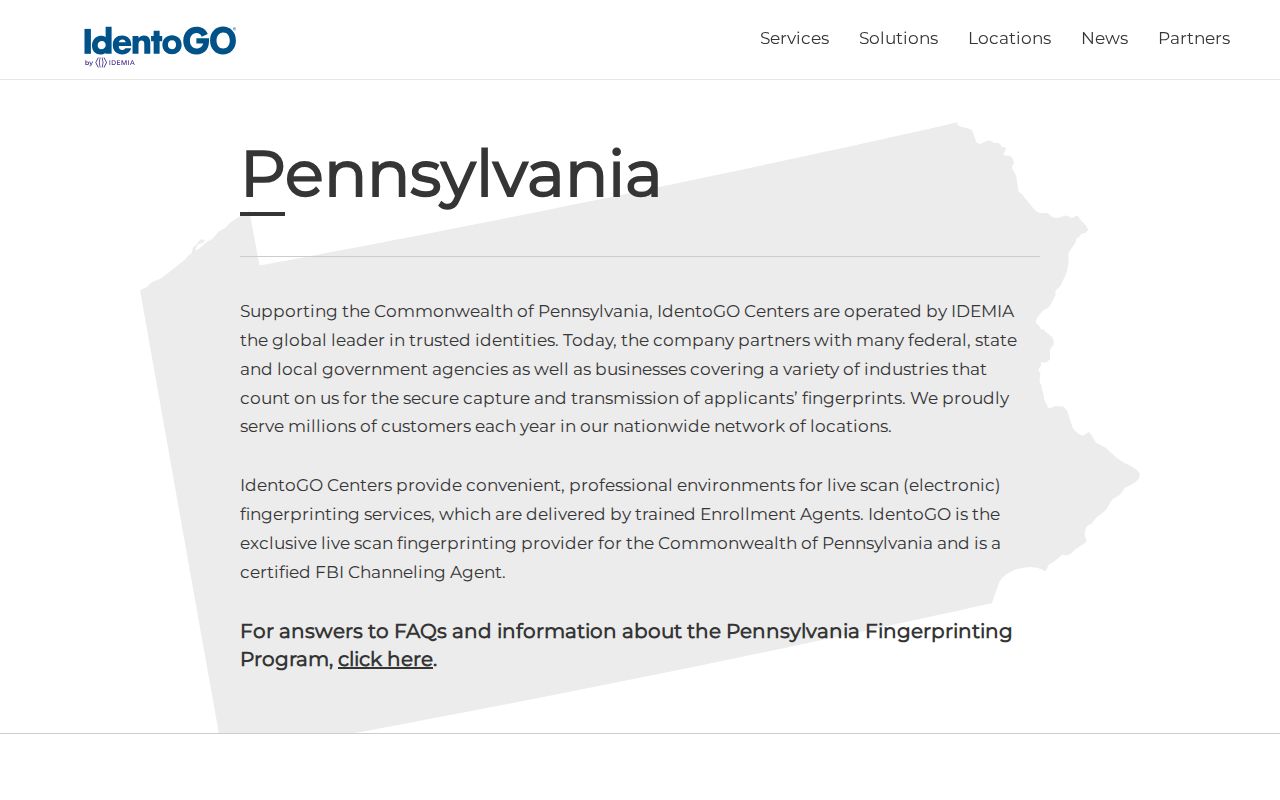
The service code controls the program and fee. It should come from the agency that requires the statutory check, not from a guess based on location.
Criminal Record Types
Fayette County criminal records are split by the act that creates them. Police write incident and arrest reports. Jail staff create booking and custody records. Magisterial District Courts open complaints and record preliminary events. The Clerk of Courts maintains felony and misdemeanor cases after they are held for court. PSP compiles reportable arrest and disposition data in the central repository.
- Incident report: the creating agency's account of the event, subject to investigative and privacy limits.
- Booking record: jail intake identifiers, received charges, custody status, bond data and related fields.
- Court file: complaint, information, motions, pleas, orders, verdict and sentence.
- Repository history: PSP's identity-linked compilation of qualifying arrest cycles and outcomes.
- Supervision or registry record: separate probation, parole, prison or Megan's Law information.
A warrant is also its own court and law-enforcement record. An unserved warrant may not appear in a public search, and a sealed search-warrant affidavit can remain unavailable.
Fayette County's East Main Hub
The Fayette County Courthouse at 61 East Main Street in Uniontown is the center of the county criminal case system. Clerk of Courts, Common Pleas, Court Administration, the Sheriff and Public Defender use that address. The Clerk says most criminal records are open for inspection, apart from juvenile matters, child-victim records and other protected material. Court Administration is on the third floor and publishes calendars, current MDJ information and access forms.
Several linked offices sit elsewhere. Adult Probation and Parole is at 22 East Main Street, third floor. The county directory places the District Attorney at 97 East Main Street. The address split matters. Call the correct office before a visit, especially when a county page carries a general courthouse footer.
Clerk and Common Pleas
61 E. Main St., Uniontown, PA 15401
724-430-1200
Sheriff's Office
61 E. Main St., first floor
724-430-1295
Note: Courthouse security controls devices and entry, so ask Court Administration about current access, interpreter help and courtroom location.
Inside a Fayette County Criminal Record
A Fayette Common Pleas docket begins with a number such as CP-26-CR, where 26 is the county code. It identifies the caption, court, filing date and status, then separates each charge by statute, grade and disposition. Bail entries, attorneys, hearing events, motions, pleas, sentencing terms and appeals may appear as the case develops. Protected identifiers and sealed material do not belong in the public display.
| Name and identifiers | Public participant details used to distinguish the case, with sensitive data limited. |
|---|---|
| Arrest and booking | Agency, date and related tracking information when entered in the case. |
| Charges | Separate counts with statute, description, alleged offense date and grade. |
| Disposition | The outcome for each count, such as guilty, dismissed, withdrawn or acquitted. |
| Sentence | Confinement, probation, concurrent or consecutive terms, credit and obligations. |
| Supervision | Public sentence and revocation events, not confidential probation case notes. |
“Held for court” means a charge moved beyond the MDJ stage. It does not mean guilty. Likewise, a case-level label can hide different outcomes among its counts.
Searching Fayette County CP-26-CR Dockets
UJS supports participant, docket-number, organization and court-specific search paths. Select Court of Common Pleas or Magisterial District Court, choose Fayette County and use the criminal category. A CP-26-CR number is the fastest path to the Common Pleas case. Name searches benefit from a middle name and a narrow filing-date range.
| Portal field | How it helps | Fayette detail |
|---|---|---|
| Court Type | Separates MDJ and Common Pleas cases | Search both for a full case route |
| Case Category | Filters record class | Select Criminal |
| County | Limits statewide matches | Select Fayette |
| Participant Name | Finds possible name matches | Add middle name and date range |
| Docket Number | Opens a known case | County code is 26 |
The free docket is not an attached-document library. Ask the Clerk for the actual file, older material, certification or a copy suitable for the reader's purpose.
Public Access Laws in Pennsylvania
Different rules govern agency reports, criminal-history dissemination and court records. The Pennsylvania Right-to-Know Law gives a route to request existing county or police-agency records, but its criminal-investigation exemption can protect narratives and evidence. Judicial files follow Pennsylvania court access policy and the record custodian. PATCH disclosures follow CHRIA rather than ordinary county copy practice.
Key access rules:
65 P.S. §67.701 provides access to nonexempt agency records during regular business hours.
65 P.S. §67.708(b)(16) protects qualifying criminal-investigation records.
18 Pa.C.S. §9121 controls police dissemination of criminal-history information.
Pennsylvania court access policies govern public judicial and case records.
18 Pa.C.S. §9122 defines circumstances for expungement.
Fayette County and state offices may redact victim, juvenile, medical and personal identifiers. When part of a record is protected, request the public portion and a written citation for any denial.
Requesting Fayette County Records Offline
The county's Downloadable Forms page carries the Fayette Right-to-Know request route. Describe an existing record, identify the agency and date range, and add an incident, case or booking number when known. State whether inspection, paper copies, an electronic copy or certification is wanted. Pennsylvania agencies normally have five business days for an initial response, subject to a lawful extension notice.
The Office of Open Records fee schedule shows the statewide framework used for agency-copy requests.
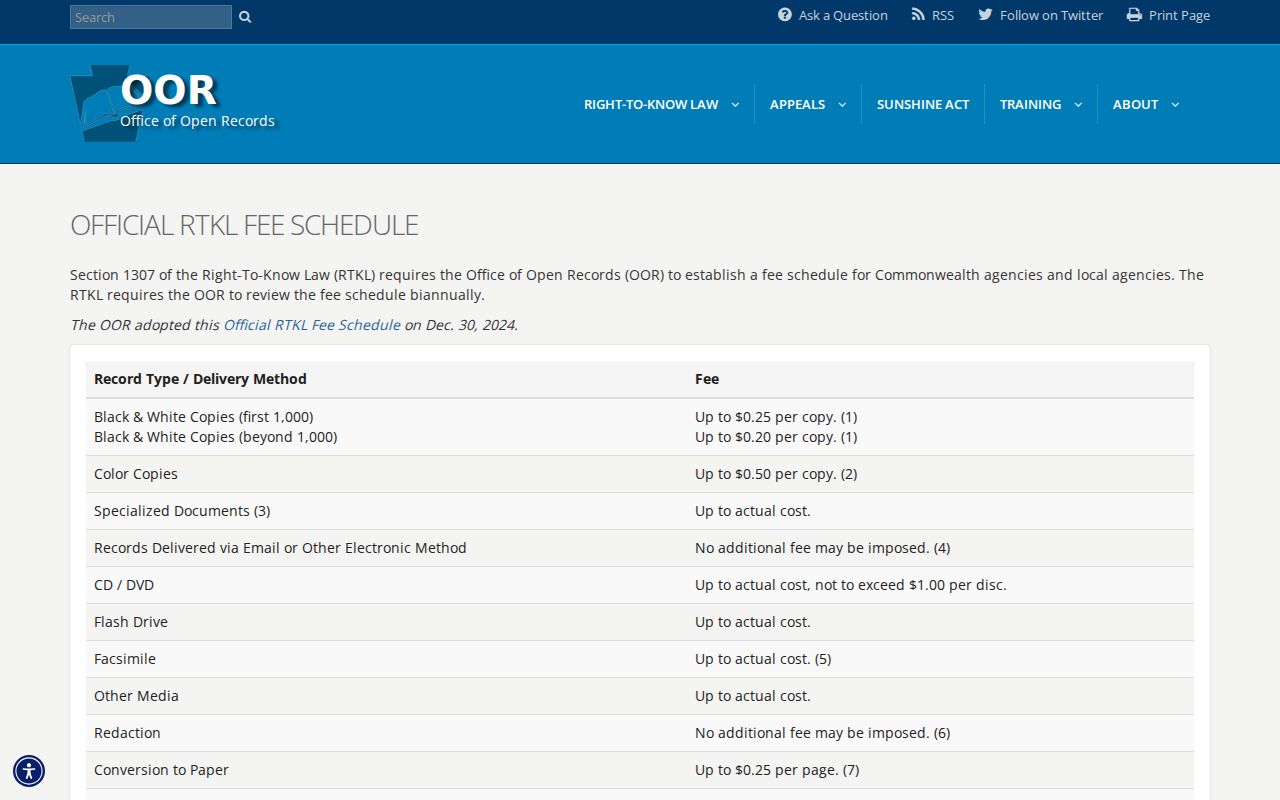
Black-and-white copies may cost up to 25 cents per page. Police crash reports and PSP full reports have separate statutory prices, so confirm the record type before paying.
Sealed, Expunged, and Restricted Records
Pennsylvania distinguishes expungement from Clean Slate limited access. Expungement removes or destroys qualifying record information through the statutory process. Limited access shields eligible information from general public view while preserving authorized access. Juvenile, child-victim, sealed and protected personal data may also be absent or redacted for separate reasons.
Eligibility depends on the disposition and the law. A pardon does not erase a docket by itself. Someone reviewing their own Fayette County criminal record should begin with the exact docket and disposition, ask the Clerk for current forms and fees, then verify later changes in both UJS and a PSP access-review record. Processing can take time across the Clerk, PSP and the arresting agency.
Fayette County ARD Uses CP Numbers
Fayette County's Accelerated Rehabilitative Disposition program is a local path for some first-time, nonviolent cases. Successful completion of required classes, counseling, service, restitution and costs may lead to expungement. Admission remains discretionary, and the county's published policy controls the application route.
The local detail most likely to cause delay is the docket number. The Fayette ARD instructions require the Common Pleas number, not the Magisterial District Court number. Applicants submit the original plus three copies of the eight-page application to the District Attorney. When required, the waiver of arraignment and plea form also goes to the Clerk as an original plus three copies.
The Fayette District Attorney page identifies the office that administers the county program.
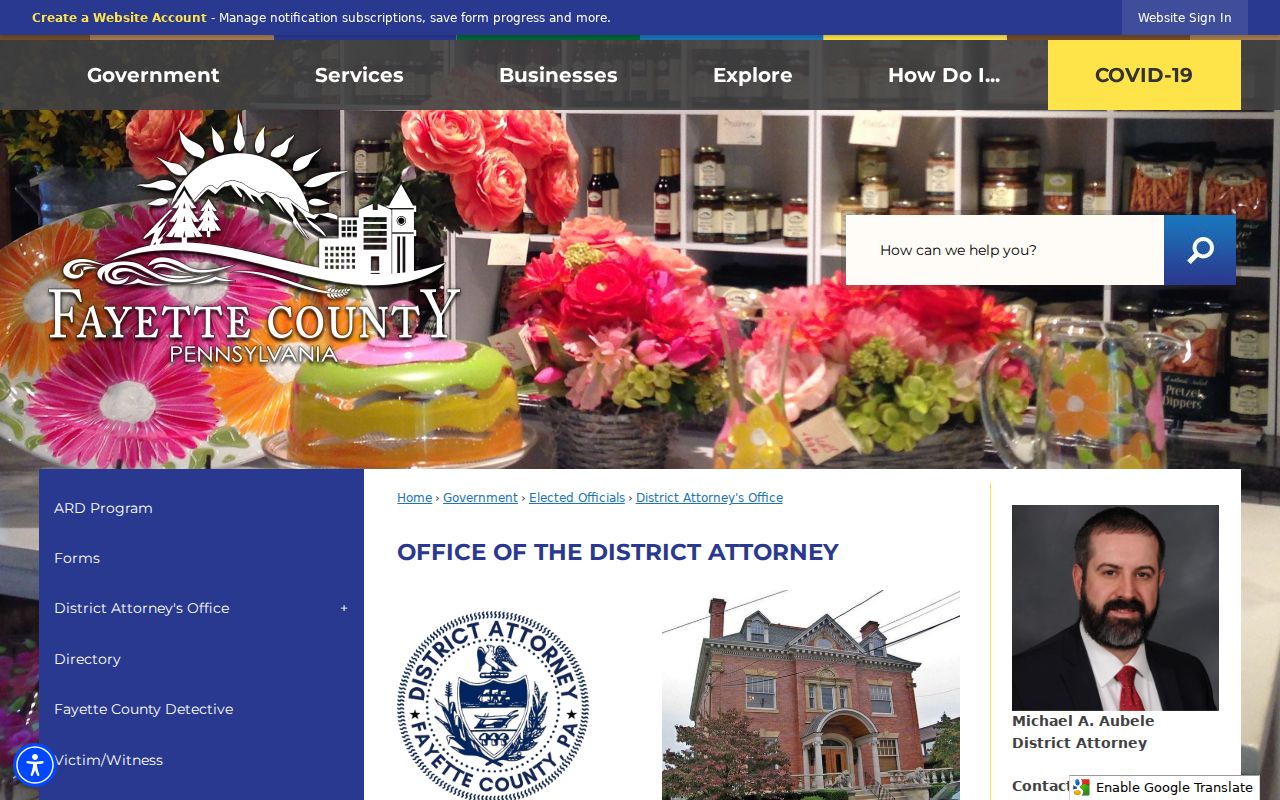
The District Attorney is at 97 East Main Street according to the county directory, while the Clerk is at the courthouse. The Fayette Public Defender handles qualifying criminal matters from 61 East Main Street.
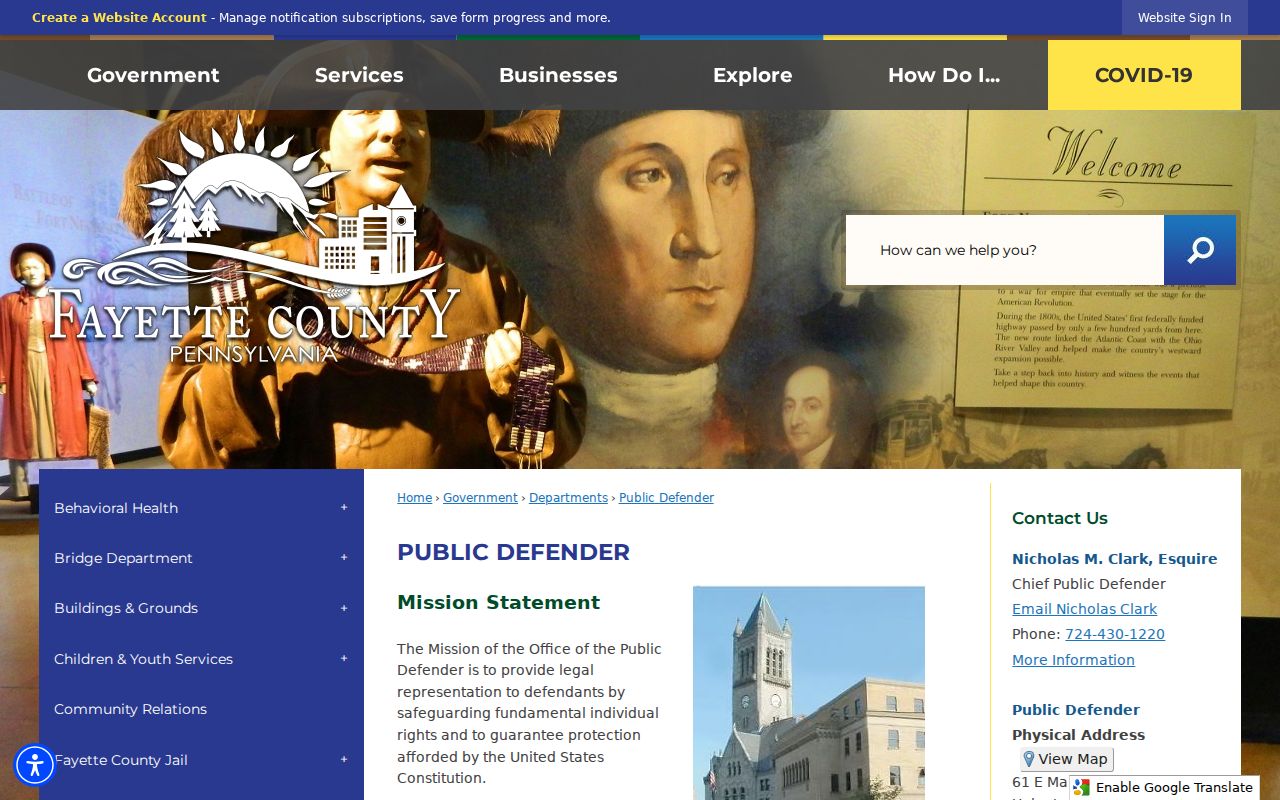
The separate office hours and addresses reinforce why the CP-26-CR number should follow the case from one counter to the next.
Fayette County Jail Records Use an App
The official county Inmate Lookup page does not show a current browser roster. It says “Update pending” and sends readers to the Fayette County PA Sheriff mobile app for the most up-to-date inmate list. That app-only route is useful for current local custody, but an absent name does not prove that no arrest occurred. Release, transfer, a citation, spelling differences or indexing delay can explain the gap.
The new Fayette County Jail is at 254 McClellandtown Road on the former Army Reserve Center site. It is not the downtown courthouse. Call 724-430-1222 for public custody information and current procedures. For a sentenced state prisoner or parolee, switch to the PA DOC Inmate/Parolee Locator. The jail also warns that it and its affiliates do not solicit money for an incarcerated person, so unexpected calls demanding funds should be treated as scams.
The arrest-specific access chain also separates local custody from the later court outcome and statewide repository record.
Booking starts with identity checks, property intake, a photograph, fingerprints, listed charges, health screening, classification and verification of the court's commitment or bail order. Those fields describe what the jail received at intake. The District Attorney may later change the counts, and the court controls bail and release orders. When the app and docket differ, record the booking date, check both MDJ and Common Pleas levels, then ask the jail which public custody fields are current. Medical information and internal classification details are not ordinary public roster data.
Fayette County Criminal Records by City
Fayette County has two legally incorporated cities, Uniontown and Connellsville. Each city police department keeps the reports it creates. A city arrest can then produce a Fayette Jail entry, an MDJ complaint and, if held for court, a CP-26-CR file. City Hall, the courthouse and the jail are separate record counters.
Uniontown Criminal Records
2025 estimate: 9,434. Start city-created reports with Uniontown Police.
Connellsville Criminal Records
2020 Census: 7,031. Start city-created reports with Connellsville Police.
Large Fayette boroughs do not replace a missing third incorporated city. For either city, use UJS for filed court cases and PATCH for the separate statewide repository product.
Fayette County Warrants Without a Portal
No official countywide public warrant-name portal was documented. A blank web search cannot rule out a warrant. Search the related Fayette docket in UJS, contact the issuing Magisterial District Court or Common Pleas office, and call the Sheriff at 724-430-1295. A bench warrant often follows a missed hearing or failure to comply. An arrest warrant can remain outside public view before service.
Someone addressing their own possible warrant should identify the court and docket, seek counsel if desired, and ask the court for current appearance or surrender instructions. Staff cannot simply cancel a judicial order at the counter. After the matter is resolved, obtain written court confirmation and allow time for each record system to update.
The office holding the linked record depends on the warrant. UJS and the issuing court can explain public docket activity. The Sheriff handles its own service and enforcement records, while a municipal police department or PSP may hold the incident report tied to an arrest. A Right-to-Know request still cannot force release of protected investigative material. Giving the agency a docket number, date range and exact existing record description produces a clearer request than asking for every detail about a person.
Do not arrive at a courthouse or police office on the assumption that an online search cleared a possible Fayette County warrant.